

Data Centers Data
GeoTel’s data center intelligence unites facility locations, operators, and network proximity into one powerful, map-first view. With a data center location database available in GIS and TeleTracker, teams can review physical locations, compare facility types, and evaluate how network connectivity supports workloads. The dataset helps planners, enterprises, and public agencies understand where modern and traditional data centers are located, how those sites relate to routes and markets, and where to focus follow-up work.
Why Teams Choose Data Centers Data
Data centers are essential to modern society because they store data, process workloads, and support cloud services that keep businesses running. A clear picture of physical data centers and nearby infrastructure reduces guesswork and improves planning. With a single source that provides physical locations, operator references, and surrounding routes, teams can align siting decisions, project sequencing, and communications with measurable milestones that matter to leadership.
Benefits

Support siting, interconnection checks, and market evaluation with consistent attributes
Compare operators and facilities across regions in the global data center market
Provide visuals that translate complex data center infrastructure into concise information for decision makers
What the Data Center Location Database Includes
Facility and Location Context
The dataset identifies physical locations of data center facilities, with basic mapping and search identifiers.
- Records help distinguish types of data centers, including enterprise-operated sites and colocation facilities used by multiple customers.
- Notes can support review of data center tiers and operational context relevant to planning.
Teams use this view to understand how a single data center relates to nearby routes and to other data centers in the same market.
Types of Facilities for Context
The data support comparisons across:
- Traditional data centers
- Cloud computing data centers
- Edge data centers,
- Facilities oriented to hyperscale data centers
Many organizations also review how cloud providers and public and private clouds influence market dynamics. Examples often mentioned in planning discussions include Google Cloud Platform, AWS, Meta, and other providers that operate at scale. The database provides a neutral map view so teams can evaluate proximity and options without prescribing a ranking.
Network and Market Attributes
Attributes help analysts evaluate network infrastructure and interconnection options around each site. These fields support conversations about access to transport, proximity to fiber routes, and the potential to connect additional services. Operator references help with regional comparisons when multiple data centers are located near a corridor or metropolitan area.
Access and Delivery
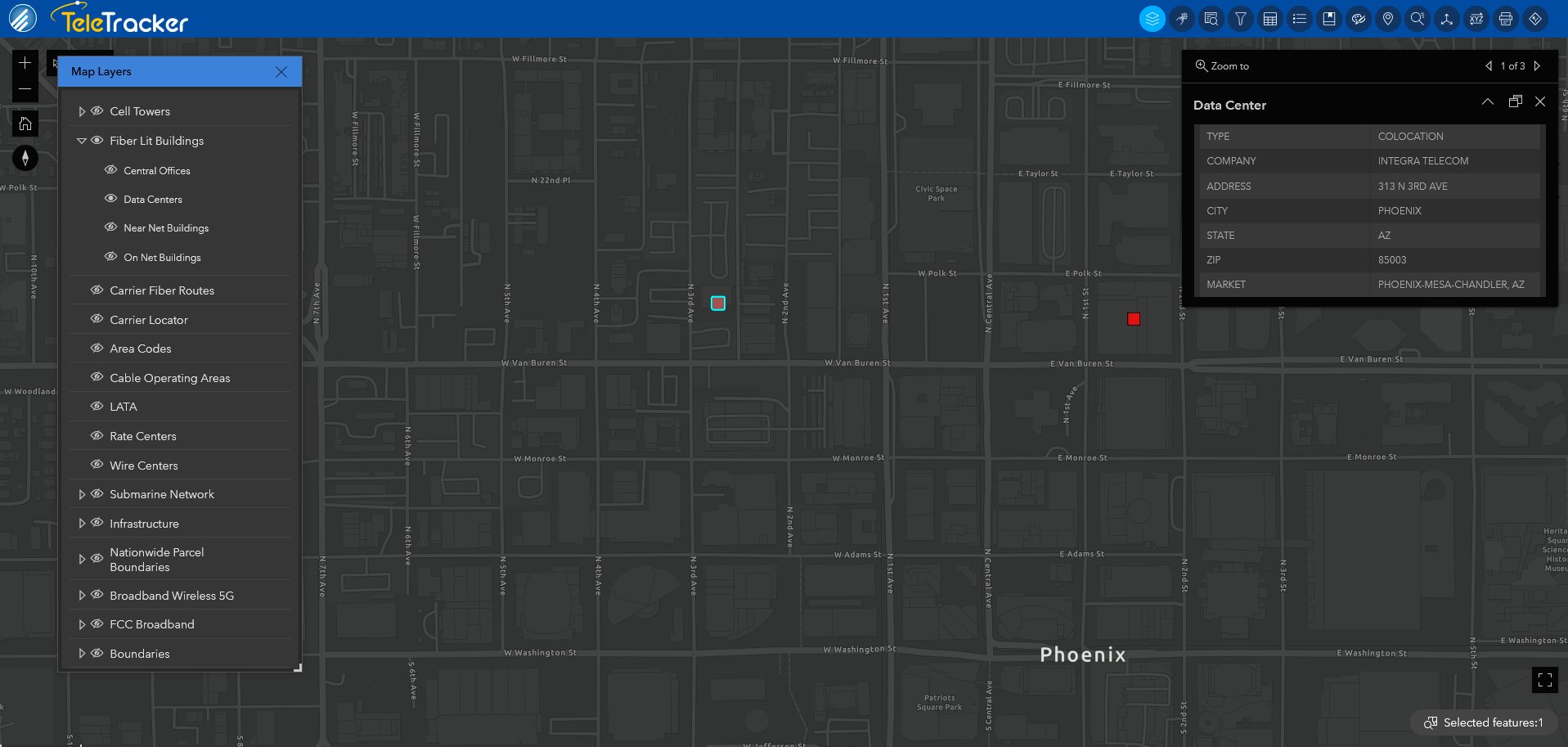
Choose native GIS formats for analytical workflows or open the same data in TeleTracker for a browser-based review. In both environments, users can search by address, pan across a region, open attributes, and export a clean image or file that keeps reviewers aligned on one page of information.
Who Uses Data Centers Data
Network Operators and Providers
Operators evaluate routes near facilities and plan access that aligns with transport paths. The combination of data centers, data, and telecom layers helps determine how to connect customers to enterprise data center options and where to stage upgrades as demand changes.
Enterprises and Site Selection
Enterprises compare candidate sites for workloads that depend on reliable network connectivity and storage services. Teams look for locations where physical infrastructure aligns with goals for latency, availability, and cost, then confirm that the surrounding network can meet requirements for remote access and integration with existing IT systems.
Real Estate and Market Analysis
Owners and brokers position commercial assets with verified proximity to data center infrastructure. The database supports narratives about connectivity advantages for tenants whose operations depend on data storage, computing resources, and access to external networks.
Government and Economic Development
Public agencies review where facilities cluster and how they support regional growth. The same view helps identify areas where additional network infrastructure would improve access for organizations that rely on business-critical data.
Consulting and Business Intelligence
Consultants and BI teams incorporate the data center location database into models and dashboards. Clear maps and companion tables turn data center design and interconnection topics into brief summaries that leaders can evaluate quickly.
Planning and Analysis Workflows
Market Scan
-
Begin with a scan that shows where modern data centers and traditional sites cluster by region.
-
Identify gaps where facilities are limited, then prioritize follow-up checks near routes, campuses, or industrial corridors.
-
This step directs attention toward places where new projects are likely to succeed.
Address Review
-
Search for an address.
-
List nearby facilities.
-
Compare options that fit timelines and objectives.
-
Review the network equipment and transport context to ensure siting decisions reflect practical paths for interconnection with external networks.
Project Prioritization
-
Document why a site was selected by pairing the map with short notes.
-
Teams can record operational signals, nearby routes, and any dependencies.
-
The result is a concise record that moves projects from planning to action without repeated rework.
Integration and Compatibility
GIS Integration
Load the data center location database into your GIS to combine it with telecom layers and internal references. Analysts frequently align facilities with Carrier Fiber Routes to understand transport choices. This view supports repeatable analysis and reporting with standard outputs.
TeleTracker Use
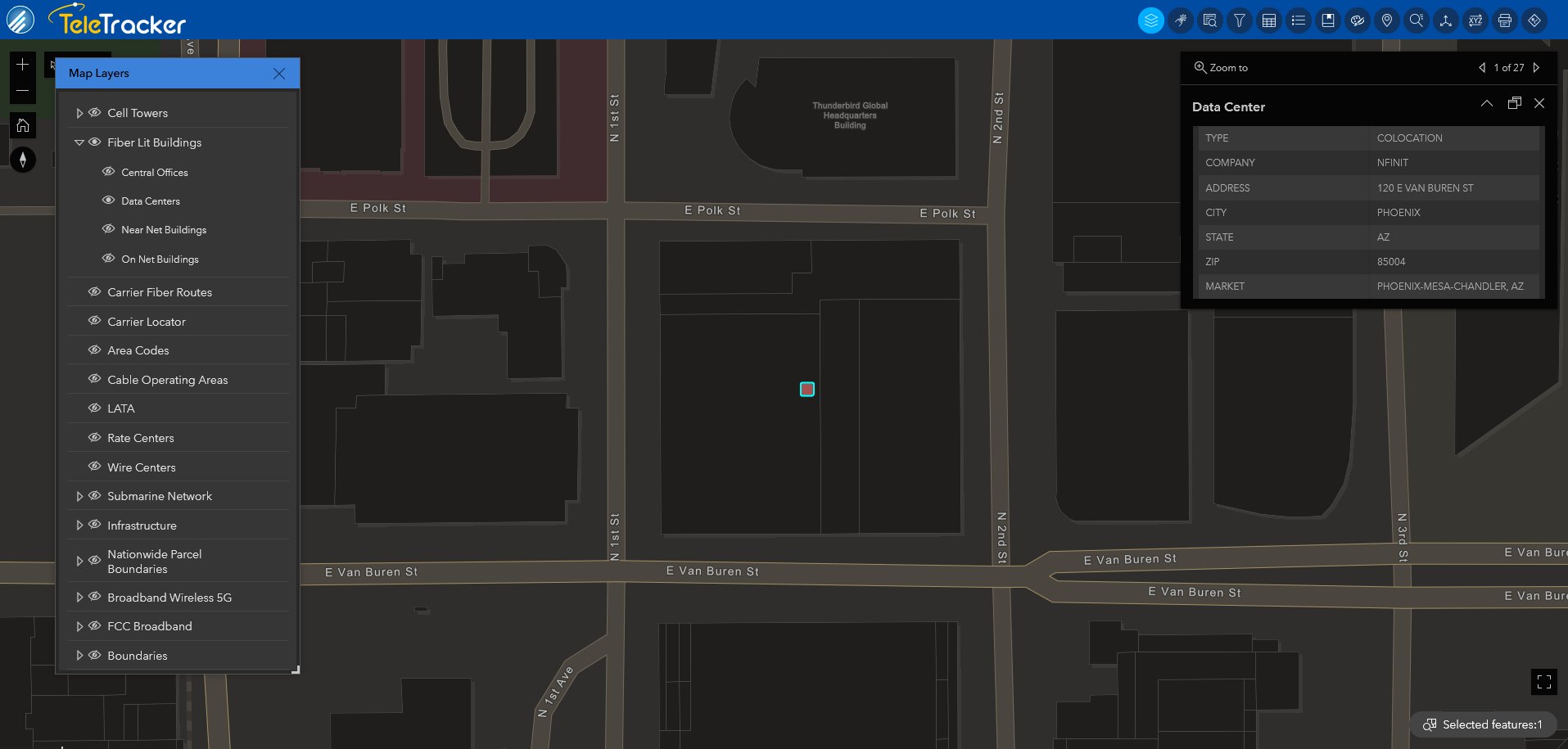
TeleTracker provides browser-based access to the same information. Users navigate to a facility, open attributes, and export a clean view for reviews and approvals. Shared access keeps engineering, strategy, and finance aligned on one consistent picture.
Schema Highlights
Common Fields
- Facility identifier, name, and address
- City, county, state, and other location descriptors suitable for search and filtering
- Facility type indicators to identify enterprise data center, colocation facilities, cloud-oriented sites, and edge data centers
- Operator references to assist with regional comparisons
Optional Context Fields
- Notes that support the discussion of data center tiers and operational considerations
- Market tags used in your internal models to organize reviews across multiple data centers or corridors
Schema fields are structured to support analysis without prescribing a third-party ranking or metric.
Related GeoTel Datasets
- Carrier Fiber Routes. A transport and interconnection perspective that shows how routes approach facilities. This helps teams evaluate feasible paths for new connections.
- Fiber Lit Buildings A location-level view of on-net and near-net buildings that signals demand near facilities. Pairing this dataset with data center data can help sequence outreach and service planning.
- Telecom Infrastructure Layers Additional context that rounds out planning from routes to sites. Combining layers gives analysts an end-to-end picture of connectivity that is easier to communicate.

Outcomes You Can Expect

Strategy and Operations
Teams shorten the time from question to decision by keeping facilities, connectivity context, and address checks together. The result is a plan that ties business goals to mapped information and milestones that can be tracked with clarity.
Stakeholder Communication
Maps and concise lists make complex data center infrastructure easier to discuss. Decision makers receive a one-page document that explains options, trade-offs, and next steps without technical overhead.
Getting Started
Simple Path to Access
Confirm specifications, fields, and coverage for your target markets.
Begin analysis, export prioritized views, and share results so projects can proceed efficiently.
Data Centers Data for Confident Decisions
Use the data center location database to identify facilities, understand market context, and align network planning with real conditions. With delivery in GIS and TeleTracker and with related datasets that clarify interconnection, teams can move from site checks to action with confidence.
Frequently Asked Questions
What Aspects of Data Center Physical Infrastructure Can This Help Me Review?
The dataset anchors location and facility context so teams can frame key elements of data center physical infrastructure during planning. Analysts can note how a physical facility relates to known routes.
Do You Consider Different Facility Types, Such as Green Data Centers or Large Data Centers?
The database supports neutral labeling, so your team can tag facilities as green data centers, AI data centers, or large data centers, as appropriate. Those tags help track energy efficiency initiatives, energy-efficient technologies, and suitability for machine learning or high-density computing. The map then ties those notes to the location context so strategy and operations view the same information.
How Do the Four Data Center Tiers Fit Into Planning With This Dataset?
You can include tier notes in your attributes to reflect the four data center tiers used in many reviews. The dataset does not assign a tier for you. Instead, it provides a place to store tier context, so internal IT teams and stakeholders can interpret redundancy consistently across sites.
What About Legacy Context From Early Computer Systems and Today’s Cloud Services?
The same location framework applies to physical data centers that originated with early computer systems and to facilities that now integrate public and private clouds. You can tag the data center services your organization consumes, then relate them to physical locations to create a consistent planning picture over time.
Which Key Components Should We Capture to Guide Design Reviews?
Most organizations include a compact checklist for key components that influence siting and interconnection. Standard items include power and cooling considerations, network connectivity to external networks, space for multiple servers and storage devices, and operational notes about staffing and remote access. Keeping these items next to the map view improves collaboration and speeds decisions.
Interested in a Free Live Demo?
Experience firsthand how our comprehensive telecom datasets, advanced analytics, and user-friendly platforms can empower your business.