Not all broadband is the same. Let’s dive deep into which US cities offer the most robust fiber-optic internet availability, explain the significance of carrier fiber routes for businesses, and outline how to interpret a fiber map to assess connectivity options.
America’s Most Fiber-Dense Cities
Nowadays, the world relies on internet connections. Fiber optic internet availability is essential for most Americans. Whether you live in a fiber-dense metro city or a rural region.
A city is considered fiber-dense when it has numerous residential and commercial locations with fiber connectivity, various telecom providers, intricate carrier fiber routes, typically exhibits highly dense fiber maps, and has hundreds of Fiber Lit Buildings.
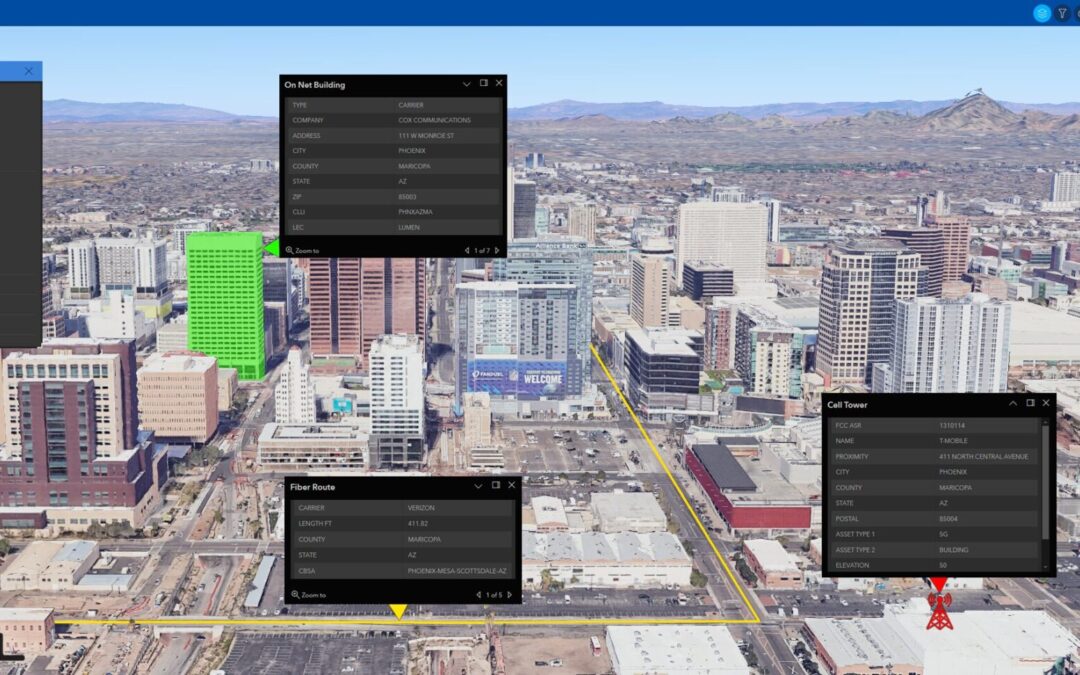
To ensure which buildings are on-net or near-net locations, groups such as network planners, procurement teams, and even real estate professionals utilize tools that provide accurate location-based intelligence of fiber locations, such as GeoTel’s TeleTracker, to show which are abundant in these cities.

Top 10 US Cities for Fiber-Optic Internet Availability
1. New York, NY
With New York’s abundance of top media organizations, financial trading, and advanced opportunities, carriers flock to the city to build redundant routes to meet these heavy data demands. The city’s many fiber-rich buildings, co-location facilities, Internet Exchange Points, and carrier access points secure its role in the telecom network worldwide as one of the most fiber-dense cities.
2. Dallas Fort Worth, TX
The DFW Worth metroplex is second on the list for most fiber-dense areas and is well-known as a major fiber hub! Infomart Dallas is a carrier-neutral facility with hundreds of Fortune 500 companies and network providers. Expanding upon DFW’s fiber presence can be easily achieved with its cost-effective land, reliable power, and favorable tax policies.
3. Los Angeles, CA
Los Angeles’s entertainment industry creates high demand for the broadband market, making it one of the top fiber-dense cities in the US. Just imagine all the billion-dollar productions and highly populated residential areas need that high-speed connection for movie streaming, production, security, and more!
4. Atlanta, GA
Atlanta is one of the most fiber-dense digital cities in the southern region of the United States. For example, 56 Marietta Street provides a highly sought-after and fiber-rich telecom hub. Top Fortune 500 companies moved to the area and have, in exchange, driven demand up. Atlanta’s airport also makes it an ideal point for data and logistics.
5. Chicago, IL
Chicago is known as a major financial hub, which creates a need for advanced fiber infrastructure. Because of this, the demand for ultra-low latency connectivity (extremely fast internet with almost no delay) has sparked more investment in fiber networks, bridging Chicago and New York. One of the biggest places for all these networks is a carrier hotel, located at 350E. Cermak Road In Chicago. It is the central location for numerous carriers, cloud providers, and enterprise networks that all operate there.
6. San Francisco, CA
San Francisco is a top contender in the top 10 cities for fiber optic internet availability, most likely because of the high population of high-speed internet users and companies. According to PPIC (https://www.ppic.org/publication/digital-access-in-california/), 90% of San Franciscans own a computer. Due to high demand, new fiber providers such as Sonic and GFiber offer competitive fiber optic internet availability in this booming city!
7. Philadelphia, PA
As mentioned previously, New York is one of the largest fiber hubs in the western hemisphere. Because of this, Philadelphia’s location between New York and Washington, D.C., makes it one of the Northeast’s most connected cities. At its core, 401 North Broad Street is a major interconnection site heavily populated with carriers and network providers. Strong demand from the region’s healthcare, education, and media sectors, like Penn Medicine, Jefferson Health, Comcast, and the University of Pennsylvania, continues to drive the need for high-capacity fiber and cloud services. Its position along key East Coast fiber corridors helps to reinforce Philadelphia’s importance in carrier networks and telecom infrastructure.
8. Houston, TX
Houston is known as a global energy hub since their economy runs mostly from energy. Because of this, they depend on high-capacity Fiber networks to support the energy industry, consisting of SCADA systems, pipeline monitoring, industrial LoT, and control centers. A good example of this is Phillips 66, a company based in Houston. They use high-energy networks to track pipelines, monitor refineries, and control valves and infrastructure. Many other companies across the Houston metro area – a few being LOGIX, Phonoscope, and FiberLight – have constructed extensive fiber infrastructure to support Houston’s continued growth in energy, healthcare, manufacturing, and technology, which is why they are known for their fiber optic internet availability.
9. Seattle, WA
Seattle’s fiber infrastructure has been heavily shaped by Amazon Web Services, which was founded in the city and remains a major global operator in the region. AWS’s extensive data center footprint in eastern Washington is linked to Seattle by some of the country’s most heavily used long-haul fiber routes. Seattle also functions as a secondary Pacific gateway, with undersea fiber routes or submarine cables to Los Angeles for handling data traffic between Asia and North America.
10. Phoenix, AZ
Phoenix has a multitude of data center markets. It has low land cost and dry climates that save cooling costs, more power is available, and its distance from many natural disaster zones has added to its appeal. The West Chandler and Goodyear corridors now host massive hyperscale campuses developed by Microsoft, Google, Meta, and colocation providers such as CyrusOne. This concentration of computing capacity has driven major investment in fiber infrastructure.
Fiber Landscape in 2026
Fiber landscapes in 2026 are evolving faster than ever. There are quite a few updates on the fiber optic internet availability at the city and state levels. Federal investment through programs like the Rural Digital Opportunity Fund has directed 4.2 billion toward gigabit-capable networks and set minimum service standards that value fiber.
Emerging markets to watch include Cleveland, where the nonprofit DigitalC is expanding a 100% fiber coverage model, as well as several Midwest cities where electric cooperatives are using existing utility infrastructure to deploy fiber more cost-effectively than traditional telecom providers.
Frequently Asked Questions – Fiber Density
How to use carrier fiber route data to find the best connectivity for businesses?
Carrier fiber route data shows where each carrier’s physical network runs, which providers are on-net at or near your location, and how competitive the market is for your building or campus. Here’s how to use that information with GeoTel:
- Check on-net status first. If multiple carriers already serve a building, users can gain immediate leverage in pricing and contract negotiations. Service can also be activated faster and add redundancy without construction.
- Map competitive density. GeoTel’s carrier fiber routes datasets help reveal where carriers overlap, where competition is strongest, and where market gaps remain by layering multiple telecom infrastructure datasets.
- Use fiber locator platforms. Tools such as TeleTracker draw on data from multiple carriers rather than relying on a single provider’s map.
Why do some large cities have lower fiber internet availability?
This is one of the most misunderstood aspects of telecom infrastructure. A city can have thousands of miles of fiber routes, hundreds of network providers, and many Fiber Lit Buildings, yet still offer limited residential fiber availability.
- Existing network infrastructure. Most large cities have had cable broadband for over 10 years. Since those networks could be upgraded over time, providers delayed larger-scale fiber-to-the-home arrangements.
- Construction and permitting complexity. Dense urban areas require carriers to navigate crowded utility areas, permitting rules, right-of-way agreements, and other infrastructure challenges, raising costs and slowing down production.
- Investment priorities. Network operators often prioritize high-growth suburbs, new developments, and underserved communities where fiber can be deployed more efficiently and at lower cost.
As a result, cities with the highest concentrations of fiber infrastructure, carrier networks, and interconnection facilities do not always have the highest residential fiber coverage.
Ready to identify on-net buildings, carrier routes, and fiber-rich markets faster?
Whether you’re sitting in a new office, evaluating enterprise connectivity, or planning network infrastructure, understanding local carrier fiber routes is the first step.
Request a Demo Connect with Telecom Data Specialists today!