Thanks to advances in telecommunications infrastructure, geospatial data, and digital twin modeling, urban planning has undergone profound change. Here is how GeoTel supports modern urban planning, why the timing is right, and what city governments, developers, and infrastructure owners need to know.
Why Urban Planning Matters Now
As cities grow, infrastructure ages, and digital connectivity becomes critical. Today, urban planners grapple with an array of challenges-from climate resilience and sustainable land use to walkability and digital inclusion. Planning today must include not just physical infrastructure but also robust digital networks for broadband, 5G, and IoT. It’s no longer about designing roads and zoning but making data-driven decisions that connect people, places, and systems.
A recent news feature demonstrates this transition. AR models under the purview of the Tampa Bay Regional Planning Council illustrate what climate-resilient infrastructure will look like in reality to its residents. It strengthens public engagement and transparency in planning. Business Insider
That means urban planning is no longer just about zoning and roads; it’s about integrating infrastructure, environment, connectivity, and people through data-informed decision-making.
How GeoTel Serves Urban Planning
GeoTel specializes in telecommunications infrastructure data and geospatial solutions, but plays a very relevant role in urban planning. A few critical points include:
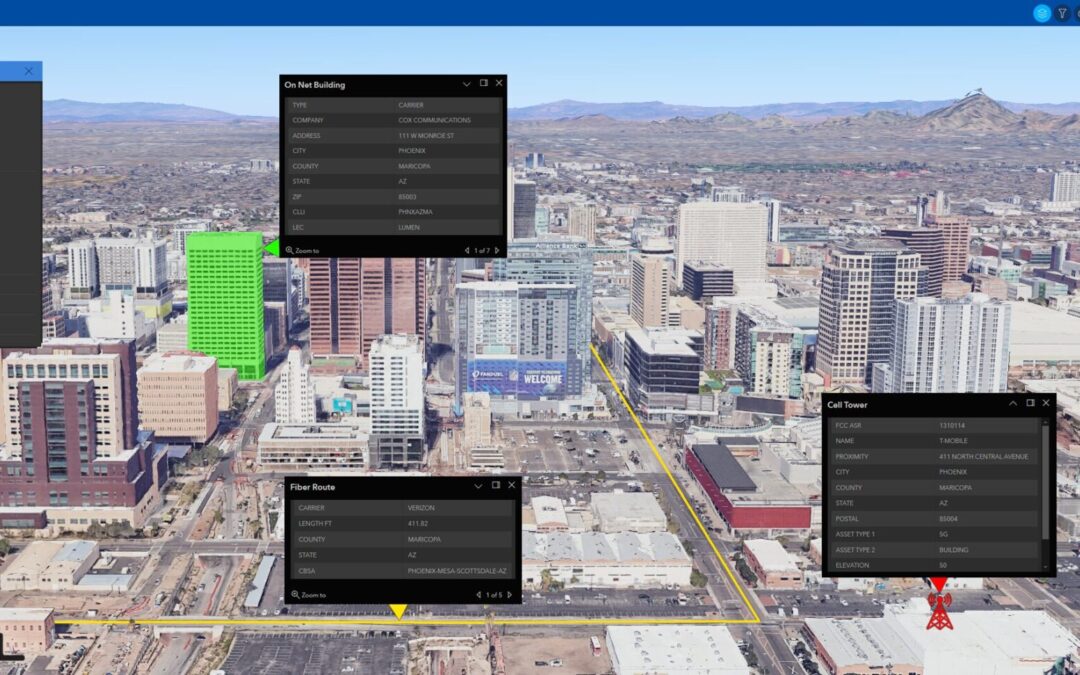
GeoTel provides detailed telecom datasets for Fiber Routes, Fiber Lit Buildings, Cell Towers, Central Offices, Terrestrial Cable, etc.
• GeoTel delivers the comprehensive set of telecom services insights required to drive wiser, data-driven infrastructure development in urban planning.
• GeoTel’s TeleTracker mapping provides visibility to connectivity alongside other infrastructure layers to enable smarter decisions on where to build, upgrade, or deploy services.
• The GeoTel article entitled “Top Trends for 2025 in Telecommunications and Tech” articulates that the continuing trends in telecom and connectivity are going directly into infrastructure and urban contexts.
That means that for any new neighborhood being planned, cities need accurate telecom and GIS data for transit corridors, utility upgrades, and digital infrastructure investments. GeoTel fills that niche by making complex network data accessible and usable.
Key Trends in Urban Planning for 2025
The following are some of the major trends in urban planning and how GeoTel’s role intersects them:
1. Digital Twins & Real-Time Urban Modeling
Urban digital twins are virtual, data-driven models that let cities simulate the behavior of traffic, energy, infrastructure, and environmental systems. They are growing in popularity, but, as Geo Week News puts it, most models today still overlook the human, social, and participatory aspects of urban life.
The connectivity layers, like telecom networks and fiber infrastructure, should feed into the digital twin to really support planning through dynamic modeling of communications infrastructure in concert with roads, utilities, buildings, and sensors. GeoTel’s datasets are key inputs to that kind of modeling.
2. Connectivity as an Infrastructure Layer
Previously, urban infrastructure planning focused on roads, water, and power alone; now, cities are redefining that to also include broadband, fiber, 5G, and IoT. In fact, GeoTel showcases this shift in the energy sector by noting that its precision-mapping tools can “optimize resources for projects under the $10.5 billion GRIP Program by accelerating planning, deployment, and maintenance.”
In practical terms, planners who don’t consider telecom connectivity are actually building spaces that can be underserved, less resilient, or unable to support future digital demands, such as remote work and smart city sensors.
3. Sustainability, Resilience, Data-Informed Design
Modern urban planning emphasizes sustainability through low-carbon or nature-based solutions and resilience in the face of climate risks, using smart, data-driven designs. To achieve these, tools such as generative AI, GIS, and other geospatial technologies have played key roles.
GeoTel grounds the telecom/geospatial data that planners can use to introduce connectivity into sustainability/resilience scenarios, for example, where to locate distributed broadband nodes, fiber backhaul, or edge compute in a resilient neighborhood.
4. Public engagement and visualization
As the AR example in Tampa Bay shows, planning increasingly integrates immersive visualizations to engage citizens, showcase future infrastructure, and bring more transparency.
GeoTel connectivity data and mapping layers can be part of such visualizations by allowing visibility into, for example, fiber routes, network service coverage, and their planned expansions. This helps the community to better understand and support infrastructure decisions.
What planners and municipalities should ask
If you are a planner, city official, or developer considering how to incorporate telecom/connectivity in your urban planning work, here are some practical questions and tips:
• Data Availability: Do you have valid, updated data on telecom infrastructure like fiber, cell sites, and broadband nodes? GeoTel does provide this kind of dataset.
Layering Infrastructure: Is your GIS/planning system capable of layering in the telecom infrastructure along with utilities, roads, public spaces, transit, etc.? Integrating telecom early avoids conflicts – like dig work or right-of-way – and optimizes co-deployment.
Resilience and redundancy: As the networks become part of the critical urban infrastructure, planners need to consider aspects of redundancy, disaster preparedness, and risk of outage. Connectivity data helps
• Future-Proofing: In the face of increasing demand for bandwidth, IoT, edge computing, and remote work, is a neighborhood or zone being built with planned, rather than after-the-fact, retrofitted connectivity (near-net, on-net fiber)?
• Public Engagement: Visualized tools such as GIS/AR/VR present plans on connectivity to the stakeholders, building trust and reducing surprises that enhance adoption.
Cross-sector coordination: Telecommunications infrastructure cuts across utilities, real estate, transportation, and IT. Urban planning approaches that treat connectivity in isolation may miss synergies. Collaboration with data providers like GeoTel helps bridge sectors.
How GeoTel fits into your urban planning roadmap
Here is a simplified map of how a planning organization might use GeoTel’s offerings to enable smarter urban planning.
1. Baseline infrastructure audit: Utilize GeoTel’s telecom GIS data, such as fiber routes, lit buildings, and cell towers, to determine current connectivity within an area.
2. Integration into GIS/planning systems – Load data into your GIS environment – for example, via TeleTracker – along with the zoning, land use, utilities, transport, and flood-risk layers.
3. Scenario modeling – Use the integrated dataset to study different planning scenarios with a view to identifying where fiber is deployed for new neighborhoods, coordinating excavations with other utilities, how connectivity enables smart city sensors, and how public-private partnerships should be planned for broadband.
4. Visualization & stakeholder engagement: Present plans that show, in addition to the roads or buildings, the connectivity infrastructure-fiber routes under planned streets, cell-site placements, and IoT sensor networks. Use these visualizations in community meetings, augmented reality/virtual reality applications, and digital twins.
5. Implementation & monitoring: Utilize the dataset to monitor the progress of implementation, validate the roll-out of connectivity, support activities of maintenance/update, and perform plan updates as conditions evolve, including densification and technology evolution.
By placing connectivity on the planning map-quite literally-you’re better prepared for smart, resilient, inclusive urban spaces in the future.
Urban Planning for 2026
Urban planning today involves far more than parcel divisions, roads, and zoning. It has a dimension of connectivity that involves data-rich modeling, citizen engagement, resilience, and digital infrastructure. And it has mapping and spatial analytics at its very core.
GeoTel occupies that unique place in the ecosystem: a leading provider of Telecom Infrastructure GIS data and platforms that let planners, utilities, developers, and governments treat connectivity as a first-class planning layer. In concert with broader geospatial, AI, and digital-twin tools, the datasets from GeoTel make smarter cities not just possible but practical.
Whether you’re designing urban planning, upgrading infrastructure, developing neighborhoods, or initiating smart city projects, ask yourself one thing: where is the connectivity data? If you don’t have it, you may be missing a vital piece of the puzzle. GeoTel can assist with this information for your urban planning needs.