Fiber optic networks now pass 52% of U.S. homes and businesses. This explosive growth, driven by $42.45 billion in government funding and 9 million new fiber connections, has created unprecedented demand for accurate fiber mapping intelligence. Organizations across the telecommunications industry need reliable fiber mapping software to navigate this expanding landscape. Fiber maps provide location-based intelligence essential for strategic planning, competitive analysis, and infrastructure investments.
Understanding what fiber maps are and how to leverage them has become a competitive necessity. This guide explains the technology, applications, and business value of modern fiber mapping solutions.
What Are Fiber Maps?
Fiber maps are visual representations showing the physical placement and characteristics of fiber optic network infrastructure. These geographic information system tools display precise locations of underground and aerial cables, carrier routes, fiber-lit buildings, data centers, cell towers, and telecommunications assets overlaid on maps and imagery. Unlike consumer tools showing streets and buildings, fiber maps reveal the network infrastructure powering connectivity, including network routes, connection points, and telecommunications infrastructure.
Network operators identify where carriers deployed infrastructure, which buildings have direct access to fiber connections, and where gaps exist. Real estate developers evaluate connectivity before site selection. Government agencies assess broadband availability for compliance. Financial institutions conduct due diligence on telecommunications assets.
Modern fiber maps integrate comprehensive telecommunications datasets into a unified platform accessible through GIS technology or cloud-based Software as a Service applications. These systems enable users to analyze complex network components without specialized expertise. GeoTel delivers the largest, most accurate databases available, consisting of more than 15 telecommunications datasets. For over 25 years, these comprehensive carrier fiber maps have provided businesses and government agencies with the leverage to make intelligent, location-based decisions.
How Fiber Maps Work
Fiber mapping systems integrate GIS technology with telecommunications infrastructure data to create comprehensive intelligence platforms. The process begins with field research and data collection from carriers, regulatory filings, and permits. This raw fiber data undergoes quality assurance to ensure accurate mapping before conversion to standardized formats.
Data Integration and Visualization
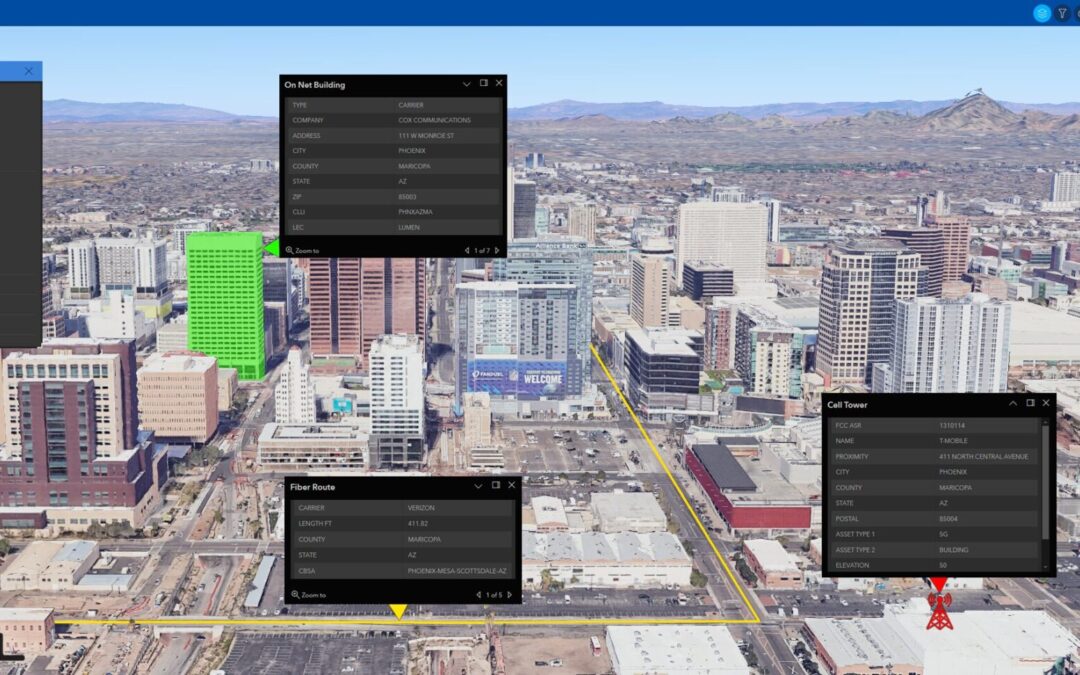
Network infrastructure data is processed with GIS technology, and each element is geo-referenced to precise coordinates. Fiber routes are digitized, showing cable paths along streets and corridors. Point features represent fiber lit buildings, cell towers, and data centers. These layers overlay onto base maps, enabling users to visualize how infrastructure relates to geography and existing infrastructure.
Integration occurs through databases that maintain relationships among network components, fiber strands, and more. Users query which carriers service buildings, trace routes, or identify assets within areas. Real-time updates ensure the system reflects current network changes.
Platform Architecture and Digital Twin Technology
Modern fiber mapping software leverages enterprise GIS systems and cloud infrastructure for scalable delivery. GeoTel’s TeleTracker platform exemplifies this architecture. This combination provides advanced capabilities without requiring specialized software installation.
Leading systems incorporate digital twin technology to create 3D models of U.S. telecommunications infrastructure. These digital twins enable users to model scenarios, assess vulnerability, and strategically plan infrastructure expansions with enhanced spatial intelligence.
The Evolution from Paper Maps to Digital Intelligence
The telecommunications industry’s infrastructure mapping has transformed dramatically. Early operators relied on paper drawings and spreadsheets manually updated when network changes occurred. Engineers marked routes on printed maps stored in filing cabinets, creating challenges for organizations needing accurate information.
Multiple map versions existed across departments with no authoritative source. Network planning relied on incomplete data, which affected network performance and operational efficiency. Digital transformation began as GIS technology matured and fiber data became electronically available, enabling better information sharing.
Cloud-based SaaS platforms revolutionized fiber mapping by centralizing data and making it web-accessible. Users no longer needed expensive software or technical expertise. This accessibility democratized intelligence, extending benefits to real estate developers, government agencies, utilities, and diverse business sectors.
What Data Do Fiber Maps Display?
Comprehensive fiber maps integrate multiple telecommunications datasets, providing complete visibility into network assets. Professional-grade systems include extensive data sources essential for network planning and operational efficiency.
Carrier Fiber Routes
Carrier fiber routes illustrate where companies deployed fiber optic cables, identifying active network infrastructure and available connectivity. Maps display metro fiber, middle-mile networks, and long-haul routes. GeoTel’s dataset encompasses millions of miles from over 7.5K telecom carriers, enabling users to quickly identify competitive landscapes for new installations.
Fiber Lit Buildings
Fiber lit buildings show locations where carriers established direct connections. Maps identify on-net buildings with physical fiber entry and near-net buildings near existing infrastructure. Data shows which carriers service each location, enabling connectivity comparison. Databases contain over 15 million locations connected through modern fiber network infrastructure.
Cell Tower Locations
Cell tower locations reveal wireless network assets critical to 5G and small-cell deployment. Additional datasets include central offices that house equipment, data centers that show colocation options, and geographic boundaries that define service territories. The table below summarizes key categories:
| Data Category | Information Provided | Primary Applications |
|---|---|---|
| Carrier Fiber Routes | Cable paths, carrier ownership, and cable placement | Network design, competitive analysis, route selection |
| Fiber Lit Buildings | Building addresses, serving carriers, on-net vs near-net | Site selection, real estate evaluation, carrier comparison |
| Cell Towers | Tower locations, carrier ownership, technology types | Wireless planning, coverage analysis, site acquisition |
| Data Centers | Facility locations, carrier presence, colocation | Colocation planning, disaster recovery, connectivity assessment |
| Central Offices | Locations, serving areas, carrier information | Network architecture, service territories, infrastructure planning |
| Geographic Boundaries | Wire centers, LATAs, service territories | Operations management, regulatory compliance, market analysis |
Who Uses Fiber Maps?
Fiber maps serve diverse organizations requiring telecommunications infrastructure intelligence for decision-making. Applications extend beyond traditional carriers.
Telecommunications providers use fiber maps for network design, management, and competitive intelligence. Engineering teams identify optimal routes. Business development locates underserved markets. Operations staff manage maintenance using records, improving service quality.
Real estate developers evaluate connectivity before acquisition. Investment firms conduct due diligence. Urban planners incorporate fiber data into economic development.
Government agencies leverage maps for regulatory compliance and broadband expansion. State offices administer BEAD funding. Utility companies coordinate fiber deployment. Educational institutions plan upgrades. This diverse customer base demonstrates scalability and broad business applications.
Key Benefits of Fiber Maps
Accurate fiber mapping delivers measurable advantages impacting operational efficiency, strategic planning, and financial performance. Organizations leveraging comprehensive data gain competitive intelligence unavailable through other resources.
Optimized Cost
Cost optimization represents a significant benefit. Aerial fiber installation costs $1 to $4 per foot, while underground fiber installation costs $15 to $30 per foot. Accurate mapping enables engineers to leverage existing infrastructure rather than constructing redundant networks. Network planners route fiber along paths with minimal obstacles. Site selectors choose buildings with existing connectivity, improving capacity, and reducing operational costs.
Risk Mitigation
Risk mitigation improves when organizations understand dependencies and identify backup options. Fiber maps reveal alternative carriers, enabling diverse path connectivity and ensuring improved operational efficiency.
Market Entry
Competitive intelligence accelerates market entry. Providers identify underserved markets. Service providers target multi-tenant buildings where competitors lack presence. Teams analyze penetration to prioritize resources toward high revenue potential and future growth opportunities.
Regulation Compliance
Regulatory compliance becomes manageable with accurate mapping supporting required reporting. The FCC’s Broadband Data Collection program requires precise geographic coverage data. Project timelines accelerate through immediate access to comprehensive intelligence, enabling engineering teams to complete designs quickly and helping organizations plan expansions effectively.
How to Access and Use Fiber Maps
Organizations access fiber mapping intelligence through several delivery methods optimized for different use cases.
Direct Dataset Access
Telecommunications carriers and organizations with in-house GIS capabilities purchase datasets for integration into existing systems. These deliver in standard GIS formats, including ESRI Geodatabase, Shapefiles, KML, and KMZ. Organizations maintain complete control and customize analysis workflows for specific business operations and projects.
Software as a Service Platforms
Cloud-based platforms provide immediate access without requiring GIS software or expertise. Users access systems through web browsers with only internet connectivity required. The TeleTracker platform offers all 15 of GeoTel’s datasets through an intuitive interface. Real-time updates ensure current data. Analytical tools enable measurements without specialized training, allowing users to manage complex network planning efficiently.
Professional Services
Organizations needing specialized analysis leverage professional services from experienced Geospatial Engineers. Custom mapping digitizes client data. Fiber infrastructure research locates routes and assesses redundancy. Site location reports support strategic selection and help telecom professionals optimize operations.
The Future of Fiber Mapping Technology
Fiber mapping advances as artificial intelligence and automation improve data accuracy for future growth. AI and machine learning automate the identification of infrastructure from imagery and permits. Computer vision detects fiber routes. Natural language processing extracts network information from regulatory filings, accelerating updates.
Digital twin technology creates 3D models integrating infrastructure with utility networks and building information. Engineers simulate scenarios and assess vulnerability. The convergence with real-time monitoring enables predictive maintenance and management.
5G and 6G deployments drive demand for granular data supporting next-generation wireless. Small cells require fiber backhaul to every node. Operators use enhanced fiber mapping software to identify optimal locations, ensuring scalability for future telecommunications technologies.
Conclusion
GeoTel delivers the industry’s most comprehensive fiber maps, backed by over 25 years of expertise. The company’s databases encompass more than 5.7 million miles of carrier fiber routes from 7,500+ carriers, over 15.6 million fiber lit buildings, and 533,000+ cell tower locations across the United States. These datasets provide the foundation for intelligent, location-based decisions driving competitive advantage across the telecommunications industry.
Contact GeoTel today to experience how comprehensive carrier fiber maps and telecommunications datasets can empower your business. Request a free demo of the TeleTracker platform or discuss custom solutions with experienced Geospatial Engineers.